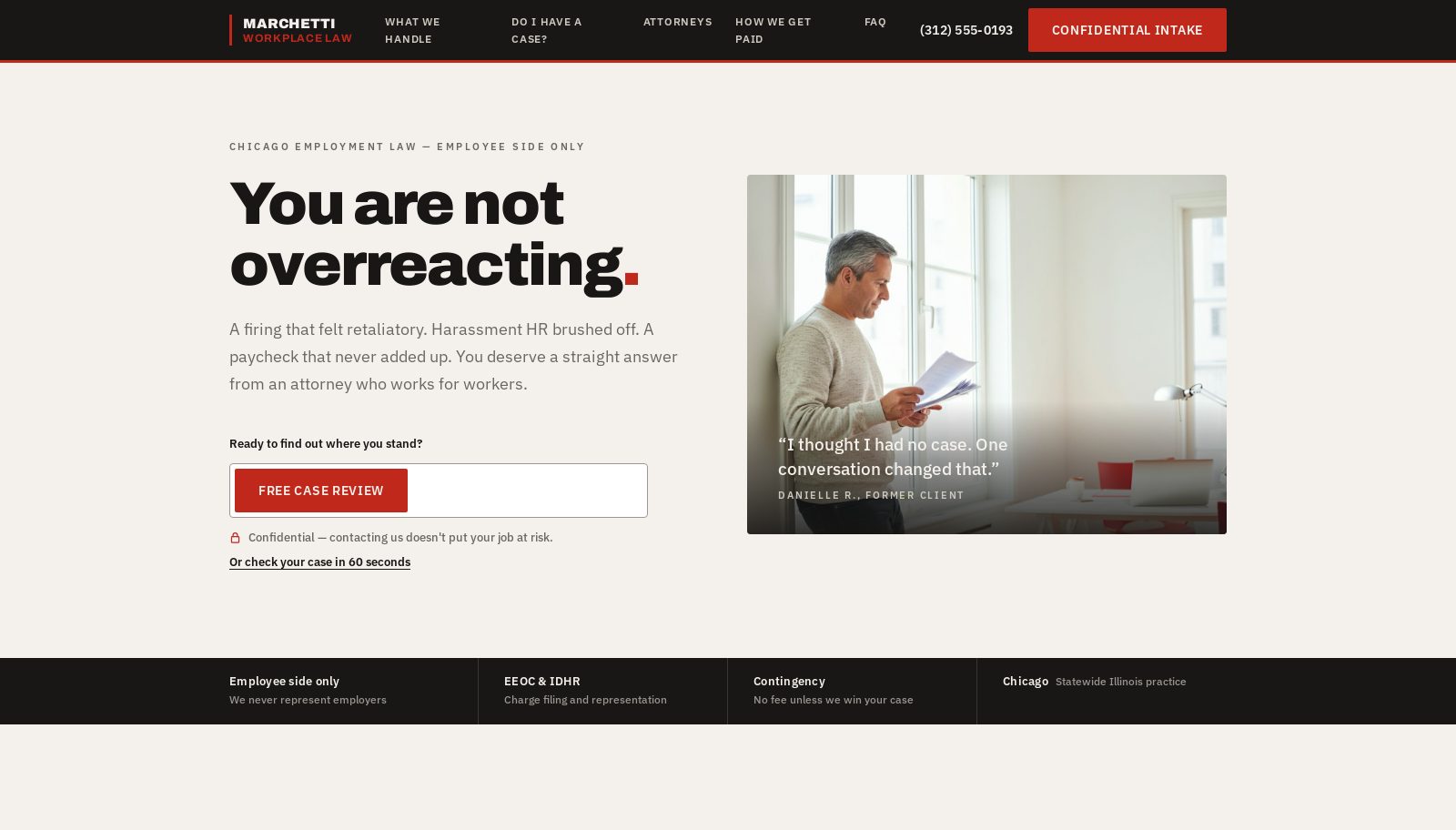
Lead with the deadline.
Filing windows for discrimination charges are short and almost no employee knows they exist. Stating them plainly converts hesitation into a call better than any persuasion copy.
Most employees have no idea an EEOC charge has a filing window. Say so clearly and you convert the visitor who was going to think about it for another month.
Real builds we can adapt for your firm, plaintiff-side or management-side. Open any of them to see the tone and structure.
The visitor is usually still in the job, worried about retaliation, and unaware that waiting has a legal cost.
Filing windows for discrimination charges are short and almost no employee knows they exist. Stating them plainly converts hesitation into a call better than any persuasion copy.
Many visitors are researching from a work computer or work network. Neutral page titles, a callback-at-a-safe-time option and clear confidentiality language remove a real barrier.
Wrongful termination, discrimination, harassment, retaliation, wage and hour, FMLA, whistleblower and severance review are distinct searches by people in distinct situations.
A plaintiff-side firm and a management-side firm are selling to opposite buyers. Running the same tone for both is the most common and most costly mistake in the practice area.
Every element is chosen for a visitor with something material to lose either way.
Filing windows for administrative charges and civil claims in your jurisdiction, stated in plain language near the top of the relevant pages. This is the most useful and most under-published information in the practice area.
Wrongful termination, discrimination by protected class, sexual harassment, retaliation, wage and hour and unpaid overtime, FMLA and leave, disability accommodation, whistleblower and severance agreement review.
Neutral page titles, a request-a-callback option with a safe time and number, and confidentiality stated before anything is asked. Visitors frequently browse on monitored networks and the design should assume it.
Plaintiff-side builds carry advocacy and accessible language for an individual under stress. Management-side builds carry preventive framing, compliance depth and the restraint an HR director or general counsel expects. We do not blend the two.
Employment claims turn on specific facts, so the intake captures employer size, dates, protected class and documentation status without becoming an interrogation, letting you triage before the consultation.
Whether you work on contingency, hourly or a hybrid, saying so up front filters the enquiries that were never going to convert and reassures those that will.
Putting the filing deadline at the top of every claim page was counterintuitive and it doubled our consultation bookings. People had no idea the clock was running.
We are management-side and every agency before this one wrote us like a plaintiff firm. This is the first site that sounds like it is talking to a general counsel.
The callback-at-a-safe-time option gets used constantly. Most of our clients are still employed and cannot take a call at their desk.
The questions employment laws ask before they hit the “get a price” button.
An employment law website from LawFirmWebDesign is $2,995 (£2,395) as a fixed one-time fee, or $3,995 (£3,195) with brand identity included. The same price applies whether the build is plaintiff-side or management-side, though the tone and structure differ substantially between the two.
Yes, prominently, and it is the highest-converting content in the practice area. Administrative filing windows for discrimination charges are short and the overwhelming majority of employees do not know they exist. Stating the deadline that applies in your jurisdiction plainly, near the top of each relevant claim page, converts visitors who would otherwise have delayed for weeks, and is exactly the kind of factual answer that answer engines cite.
No, and attempting it is the most common mistake in the practice area. A plaintiff-side firm sells to an individual who has been wronged and needs advocacy and reassurance. A management-side firm sells to an HR director or general counsel who needs preventive compliance depth and professional restraint. The tone, the imagery, the calls to action and the content structure all differ, and a site that blends them convinces neither buyer.
Because a large proportion of visitors are still employed by the company they are considering a claim against, and many are researching from a work computer or a work network. Neutral page titles, an option to request a callback at a safe time on a personal number, and confidentiality stated before any information is requested all remove a genuine and specific barrier to first contact.
Filing deadline guidance for your jurisdiction, a separate page for each claim type, discreet contact options suited to someone still in the job, a case evaluation form that captures the facts a claim turns on, clearly stated fee terms, and a tone that matches whether you act for employees or employers.
Yes, built into every site. That means a page per claim type, jurisdiction pages, LegalService schema markup, Google Business Profile setup, and deadline and process content that ranks for the questions employees and employers actually search and gets cited by answer engines.
Same approach, tuned to each practice area — pick yours and see a landing page built just for it.
Personal injury lawyer website design
Criminal defense attorney web design
Divorce lawyer website design
Immigration lawyer website design
Estate planning attorney websites
Real estate attorney website design

Fixed fee. Live in seven days. Built for your side of the practice, not a blend of both.
