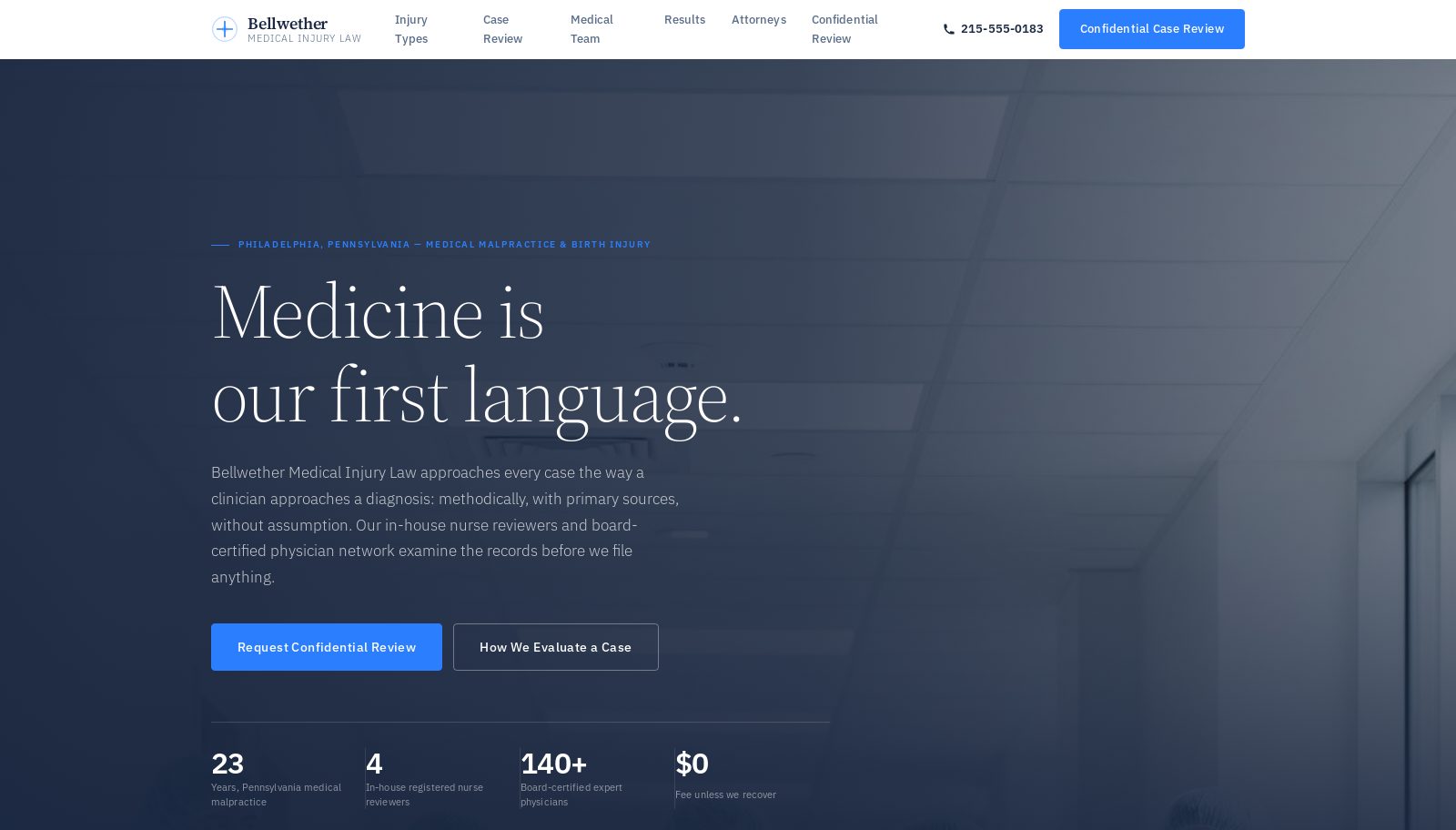
Demonstrate medical literacy.
Content that discusses standard of care, causation and specific procedures accurately signals you handle these cases. Generic injury copy signals the opposite within seconds.
This client has read their own medical records. Generic injury copy tells them immediately that you do not handle these cases, and they leave.
Real builds we can adapt for your firm. Open any of them to see how medical depth and case results are handled.
Malpractice has the longest research cycle and the most informed prospect in plaintiff work. Depth is the entire proposition.
Content that discusses standard of care, causation and specific procedures accurately signals you handle these cases. Generic injury copy signals the opposite within seconds.
Limitation periods, discovery rules and notice requirements are complex, jurisdiction-specific and decisive. Explaining them plainly is genuinely useful and converts strongly.
Almost every visitor is asking whether they have a case at all, not which firm to hire. Content that helps them assess that honestly earns the consultation.
Malpractice requires expert witnesses and serious case funding. Making clear that your firm can carry a case of this size is a genuine differentiator.
Every element is chosen for someone who has already spent months researching their own situation.
Birth injury and cerebral palsy, surgical error, misdiagnosis and delayed diagnosis, medication and pharmacy error, anesthesia error, hospital-acquired infection, emergency room negligence, nursing home neglect and wrongful death.
Limitation periods for your jurisdiction, how the discovery rule operates, notice requirements where they apply, and the different rules that commonly apply to minors. Clear, current, and dated visibly.
An honest explanation of what has to be shown, standard of care, breach, causation and damages, so a visitor can form a realistic view. Honesty here produces far better-qualified consultations.
Verdicts and settlements presented with the past-results language your jurisdiction requires. Malpractice results attract particular scrutiny, so the compliance framing is built in rather than added afterwards.
Expert witness networks, medical review capability, in-house medical staff where you have them, and case funding. These cases are expensive to run and prospects are right to check you can run one.
Intake that captures treatment dates, facilities and providers, with secure upload for medical records, so review can begin before the first consultation.
The birth injury page reads like it was written by someone who has actually tried one. That is the only reason our best case this year found us.
Explaining the statute of limitations honestly, including when it has probably already run, was the thing I resisted most. It produced better cases almost immediately.
Secure records upload at intake cut weeks off our review cycle. Clients arrive at the consultation with the file already with us.
The questions medical malpractices ask before they hit the “get a price” button.
A medical malpractice website from LawFirmWebDesign is $2,995 (£2,395) as a fixed one-time fee, or $3,995 (£3,195) with brand identity included. The build includes the injury-type page architecture and the statute of limitations content the practice area depends on.
Because the prospect is far better informed. Someone pursuing a malpractice claim has typically been researching their own medical situation for months, has read their records, and often understands the specific procedure in detail. Generic injury copy signals within seconds that a firm does not genuinely handle these cases, while content that accurately discusses standard of care, causation and specific procedures signals that it does.
Yes, and it is among the highest-value content on the site. Limitation periods in malpractice are complicated by discovery rules, notice requirements and different treatment of claims involving minors, and they vary substantially by jurisdiction. Explaining them plainly is genuinely useful, converts strongly because it creates real urgency, and is precisely the kind of factual question answer engines are asked to resolve.
A separate page for each injury and error type, a clear explanation of the statute of limitations in your jurisdiction, honest guidance on what has to be proven, case results carrying compliant disclaimers, visible evidence of expert witness access and case funding capability, and intake that captures treatment dates and providers with secure records upload.
In most US jurisdictions yes, with disclaimers, and malpractice results attract more scrutiny than most. Every state bar prohibits creating an unjustified expectation of results, and published verdicts generally require language making clear that outcomes depend on the specific facts of each case. We build result sections carrying the correct disclaimer for your jurisdiction and will advise against publishing figures where the rules make it unwise.
Yes, built into every site. That means a page per injury and error type, jurisdiction pages, LegalService schema markup, and substantive medical and legal content that ranks for the long research-phase queries these prospects actually run and gets cited by answer engines.
Same approach, tuned to each practice area — pick yours and see a landing page built just for it.
Personal injury lawyer website design
Criminal defense attorney web design
Divorce lawyer website design
Immigration lawyer website design
Estate planning attorney websites
Employment lawyer website design

Fixed fee. Live in seven days. Built for the most informed prospect in plaintiff work.
