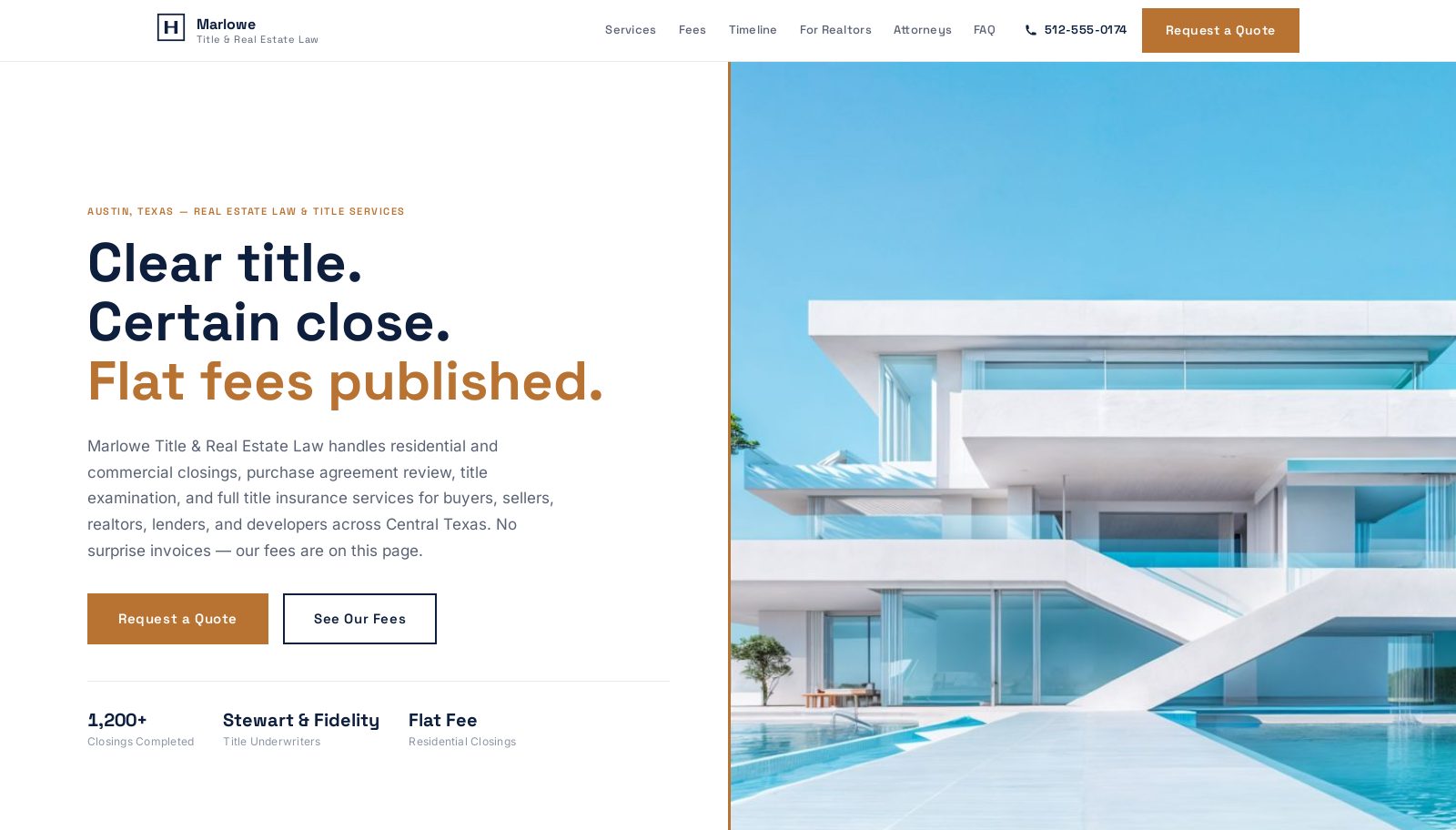
Property buyers compare three or four firms in ten minutes. Published fees, CQS accreditation and a clear turnaround promise close that decision before anyone picks up the phone.
Residential conveyancing is a price-sensitive, volume practice where the instruction is usually decided in a single online session by someone comparing tabs.
Meet the SRA transparency requirement.
SRA transparency rules require many conveyancing firms to publish price and service information for residential freehold and leasehold transactions. A site that does this well turns a regulatory obligation into a conversion advantage.
Signal CQS accreditation immediately.
The Law Society Conveyancing Quality Scheme is the quality mark lenders and estate agents look for. Displaying it prominently removes a barrier to instruction from the moment someone lands on the page.
Win the estate agent referral relationship.
A single referring estate agent can send dozens of completions a year. Most conveyancing firm websites give agents nothing at all. A dedicated referral path with direct contact and a simple file submission route is the highest-return addition available.
Address chain and completion anxiety.
The anxiety of every residential transaction is the same: will it complete on time and will the chain hold? Stating turnaround commitments and search speed plainly is more persuasive than any amount of credential copy.
What is in the site
Built for a buyer comparing firms in a single browser session.
Every element is chosen to close the gap between a Google result and a signed client care letter.
01
SRA-compliant fee transparency pages.
Residential freehold and leasehold purchase and sale fees published clearly, with disbursements itemised and the overall process summarised. Designed to satisfy the SRA transparency rules while converting better than a buried fee schedule.
02
CQS and accreditation displayed prominently.
The Conveyancing Quality Scheme mark, Lexcel where you hold it, and lender panel memberships visible on the homepage and practice area pages, not buried in an about section.
03
A dedicated estate agent referral section.
Direct contact for referring agents, a simple file submission form, turnaround commitments and co-brandable completion letters they can use with their own clients. This section is usually the highest-return part of a conveyancing site.
04
Search turnaround and completion timeline commitments.
How quickly local authority searches are ordered, typical time from instruction to exchange, and what happens if a chain delays. Certainty about the date is what every client and every estate agent is actually buying.
05
Leasehold expertise made visible.
Lease extension, enfranchisement, ground rent and service charge disputes are separate searches by buyers in distinct situations. Each gets its own page and its own SEO treatment.
06
Buyer and seller process guides.
Plain-English explanations of the conveyancing process from instruction to completion, what searches are carried out and why, and what the client needs to prepare. Content that ranks well and reduces repeat inbound calls.
07
Local SEO for the areas you serve.
LegalService schema markup, Google Business Profile setup, and a page per town or borough you complete in, so you compete where your instructions actually come from.
Word of mouth
Trusted by conveyancing across the US and UK.
“
Publishing our fees felt exposing. It turned out to be the single best thing we did. The price-shopping calls stopped and the instructions went up because people already knew exactly what they were getting.
F
Fiona Hartwell
Partner · Hartwell Property Law · Bristol
“
We added fourteen regular referring estate agents in the first eight months. Every one of them has mentioned the agent section of the site as the reason they called us.
D
David Okafor
Managing Partner · Okafor & Stone Solicitors · Manchester
“
Displaying our CQS accreditation above the fold cut the number of people asking whether we were on their lender panel. It answers the question before it is asked.
S
Sarah Pemberton
Head of Property · Pemberton Legal · Leeds
FAQ
Conveyancing website FAQs.
The questions conveyancings ask before they hit the “get a price” button.
How much does a conveyancing solicitor website cost?
A conveyancing solicitor website from LawFirmWebDesign is £2,395 (fixed, one-time fee), or £3,195 with full brand identity included. That covers fee transparency pages, CQS accreditation display, the estate agent referral section and local SEO for the areas you serve. There is no monthly retainer and no contract.
Do conveyancing solicitors have to publish their fees online?
SRA transparency rules require many regulated firms to publish price and service information for certain work types, including residential conveyancing. The obligation applies to regulated practices offering conveyancing services, and covers freehold and leasehold residential transactions. A site that meets this requirement clearly and accessibly turns a compliance obligation into a marketing advantage, since most clients actively prefer firms that publish their fees.
Why does CQS accreditation matter on a conveyancing website?
The Law Society Conveyancing Quality Scheme is the quality standard that mortgage lenders and many estate agents use to assess a firm before adding it to a panel or making a referral. Displaying it prominently reassures buyers, satisfies lender requirements, and signals to referring agents that your firm meets the standard their own clients expect. Firms that display it clearly tend to receive fewer credential-checking enquiries before instruction.
How important is the estate agent referral relationship for a conveyancing firm?
For most residential conveyancing practices it is the most important single source of instruction volume. A referring agent who trusts your firm and knows your team can send ten or twenty completions a year over many years. The lifetime value of that relationship is an order of magnitude greater than a single buyer or seller, yet most conveyancing firm websites give agents no dedicated path, no named contact and no easy way to refer a file.
Should leasehold work have its own page?
Yes. Leasehold purchase, lease extension, collective enfranchisement and service charge disputes are searched separately by people in very different situations with different urgency and different complexity. A single property page that covers all of them competes for none of those searches effectively and fails to reassure the specific client that you understand their situation.
What should a conveyancing solicitor website include?
Published fees meeting the SRA transparency requirement, CQS and other accreditations displayed prominently, a dedicated section for estate agent referral partners, turnaround and search speed commitments, separate pages for freehold, leasehold, remortgage and specialist work, buyer and seller process guides, and local SEO for the areas you complete in.
How long does it take to build a conveyancing solicitor website?
Seven working days from kickoff to live. We begin from a proven conveyancing structure, then build in your fee tables, accreditations, service areas and referral partner path. A custom ground-up build takes considerably longer without converting any better.
Do you do SEO for conveyancing solicitors?
Yes, built into every site. That means a page per transaction type, a page per town and borough you complete in, LegalService schema markup, Google Business Profile setup, and process content that ranks for the questions buyers and sellers actually search and gets cited by answer engines.
30-min call · Built for conveyancing
Be the firm every estate agent in the area refers.
Fixed fee from £2,395. Live in seven days. Built for a volume practice that runs on referral relationships.