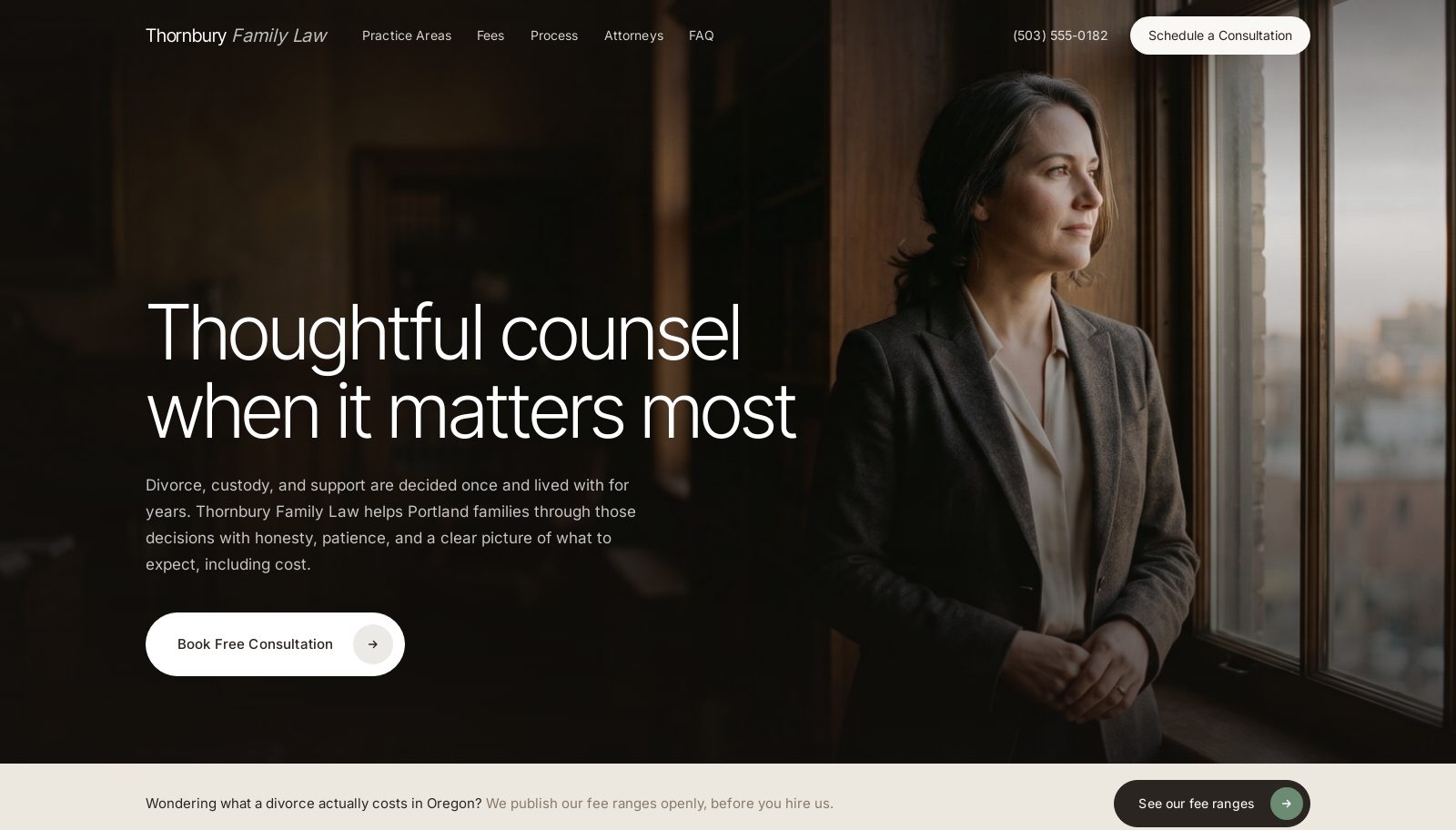
Earn trust over weeks, not minutes.
Prospective clients return to the site repeatedly before making contact. Process guides, honest cost information and genuine solicitor bios do the persuading across multiple visits.
Nobody instructs a family solicitor on impulse. They read quietly for weeks, often on a shared device, and choose the firm that made the process feel survivable.
Real builds we can adapt for your firm. Open any of them to see the tone, the process explainers, the safety features and how legal aid is addressed.
Family law has the longest and most private consideration period in consumer legal work. The site is doing its job across weeks of quiet reading, not in a single urgent visit.
Prospective clients return to the site repeatedly before making contact. Process guides, honest cost information and genuine solicitor bios do the persuading across multiple visits.
The introduction of no-fault divorce in England and Wales in 2022 changed the landscape significantly. A plain explanation of what changed, who it applies to and what the process looks like is the most-searched information in the practice area right now.
A meaningful share of family law visitors are researching while living with an abusive partner. A quick-exit control and a note about private browsing are practical safety features, not design extras, and they signal that your firm understands the situation.
Legal aid for private family law matters is restricted but available in domestic abuse cases. A clear, honest explanation of who may qualify and how to find out attracts the enquiries other firms miss by ignoring it.
Every element is chosen to reduce the emotional cost of making first contact.
A clearly marked control that immediately leaves the site, plus a short note on using a private or incognito window. Standard practice on domestic abuse support websites, still uncommon on family law firm sites, and a practical signal that you understand who is reading.
The Divorce, Dissolution and Separation Act 2020 and what it changed: sole or joint applications, the removal of fault-based grounds, the twenty-week reflection period and the new terminology. Written so someone who has never looked into it before understands where they stand.
Divorce and dissolution, judicial separation, child arrangements orders, specific issue and prohibited steps orders, financial remedy and consent orders, child maintenance, cohabitation disputes, domestic abuse injunctions and occupation orders.
Resolution membership signals a commitment to non-adversarial practice and a family-specific code of conduct. Displayed early, it reassures the prospective client who is trying to keep proceedings as constructive as possible.
An honest explanation of when legal aid may be available in private family proceedings, how to apply, and what documentation domestic abuse survivors may need. This content attracts an audience other firms are not serving.
What a divorce costs, the factors that drive that up or down, and what financial remedy proceedings typically involve in terms of cost and time. Being willing to answer the question most firms refuse to address consistently produces better-qualified enquiries.
Warm, plain and steady. No broken wedding rings, no stock photographs of distressed children, no gavel imagery. The tone of the site signals how the matter will be handled.
We added the quick-exit button on the advice of the designer and thought nothing of it at the time. Three clients have since mentioned it as the reason they trusted us enough to make contact.
Writing out the no-fault divorce process clearly doubled our enquiries from people going through a relatively straightforward separation. They had been confused about what the new rules meant for them.
Signposting legal aid on the site felt counterintuitive since we are privately funded. It brought in several referrals from solicitors who could not take legal aid cases themselves.
The questions family laws ask before they hit the “get a price” button.
A family law solicitor website from LawFirmWebDesign is £2,395 (fixed, one-time fee), or £3,195 with full brand identity included. There is no monthly retainer and no contract. That covers the no-fault divorce explainers, the matter-type pages, the quick-exit safety feature, legal aid signposting and the accessibility work a sensitive practice area requires.
The Divorce, Dissolution and Separation Act 2020 removed the requirement to prove fault or to live apart for a period before applying for divorce. From April 2022, a sole or joint application can be made on the sole ground that the marriage has irretrievably broken down, without allocating blame. There is a mandatory twenty-week period between the start of proceedings and the conditional order. Explaining this clearly on a family law website is among the most-searched and least-well-answered questions in the practice area.
Yes, if the firm handles any work involving domestic abuse, which most family law practices do. A quick-exit control that immediately navigates the visitor away from the site is standard on domestic violence support websites and remains uncommon on family law solicitor sites. For a visitor researching while living with an abusive partner, it is a practical safety feature. It also signals, without needing to say so directly, that the firm understands who its clients are.
Honestly and specifically. Legal aid for private family law matters is restricted in England and Wales but is available in certain domestic abuse cases, subject to means and merits testing and evidence requirements. A clear explanation of when it may apply, what evidence is needed, and how to find a legal aid solicitor serves a significant audience that many firms ignore. If you are not a legal aid provider, signposting the Legal Aid Agency's Find a Solicitor tool is still worth doing.
A quick-exit control and private browsing guidance, a plain explanation of no-fault divorce, a page per matter type, Resolution membership displayed early, legal aid signposting, honest cost guidance, solicitor bios with real photography and genuine tone, and a confidential and clearly no-obligation contact option.
Yes, always. Someone applying for a divorce and someone seeking a child arrangements order may be the same person at different stages or entirely different people. Separate pages let each rank independently and let the copy address the specific process, timescales and considerations that apply — including the twenty-week divorce reflection period, the MIAM requirement before applying for a child arrangements order, or the specific urgency of an occupation order application.
Yes, built into every site. That means a page per matter type, local SEO for the courts and areas you practise in, LegalService schema markup, Google Business Profile setup, and process content on no-fault divorce, child arrangements and financial remedy that ranks for the questions people search and gets cited by answer engines.

Fixed fee from £2,395. Live in seven days. Built for a decision people take weeks to make.
